AI Guard
Sarva exclusiveCameras that analyse rather than record — loitering, register events and after-hours entry raise an alert while it is happening, not at review time.
National Retail Federation, National Retail Security Survey — shrink as a share of retail sales.
Sarva is the back office and AI security layer for convenience stores and fuel retailers — one platform for what is currently five vendors, three logins and a spreadsheet.
Built and run at three Georgia stores before it was sold to anyone.
None of what follows is new to an operator. What is new is being able to see it while it is happening rather than at the end of the quarter.
Most of it is never attributed to a cause. Cameras record it; almost nothing analyses it, so the loss is discovered at inventory rather than prevented at the shelf.
National Retail Federation, National Retail Security Survey
Back office, price book, cameras, loyalty, delivery — each with its own login, its own export, and no shared view. The reconciliation between them is done by hand, usually by the owner, usually at night.
Observed across the three Georgia stores this platform was built in
On a category already running thin margins, that is frequently the difference between a profitable channel and an unprofitable one — and few operators see the per-channel number at all.
Published merchant terms, major delivery marketplaces
Each replaces something an operator is already paying for, or already doing by hand. Two of them have no equivalent in this market.
Cameras that analyse rather than record — loitering, register events and after-hours entry raise an alert while it is happening, not at review time.
Margin by item, category and channel, including the delivery commissions and labour most reporting leaves out.
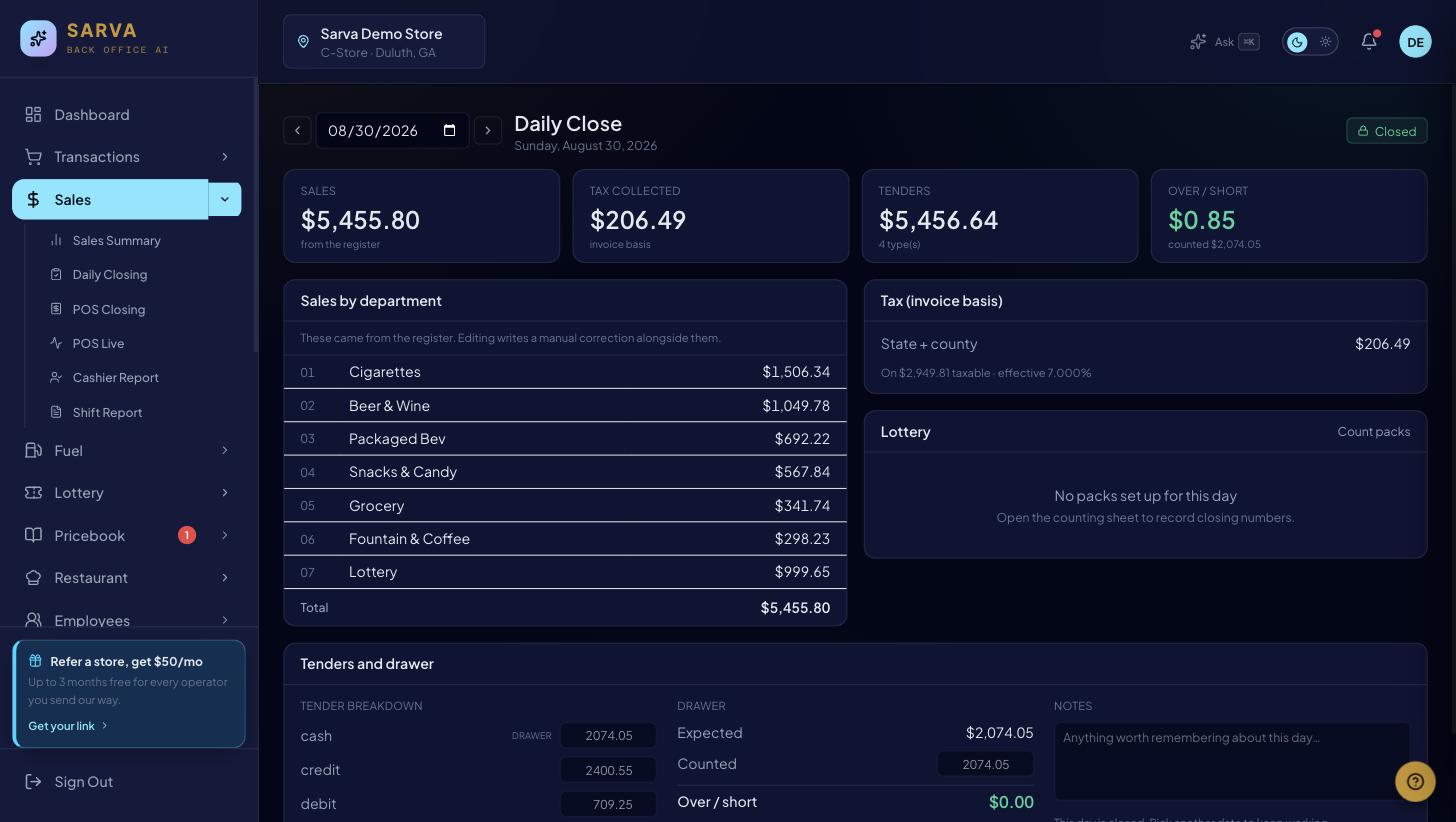
Sales, tax, tenders and lottery reconciled in one screen, with over/short derived rather than typed.
One catalogue across registers and channels, with cost-to-shelf tracking and multi-store price groups.
Adjustments with a review queue, so a large write-off is a decision someone made rather than a number that moved.
Photograph a vendor invoice; it is read, matched against the price book, and held for approval before anything changes.
Pack lifecycle, per-bin counts and variance — the highest-shrink category in most stores and the least instrumented.
Tank readings, delivery reconciliation, and the licence and permit calendar that otherwise lives on a wall.
Plain questions against your own data. It answers from what it queried, and says so when the data is not there.
An on-site connector reads your existing POS — Verifone Commander first, others behind the same interface. Sales, departments, tax and fuel arrive on their own. Until it is connected, the same screens accept figures by hand, and the changeover requires no migration.
Connectors — agent status and last sync
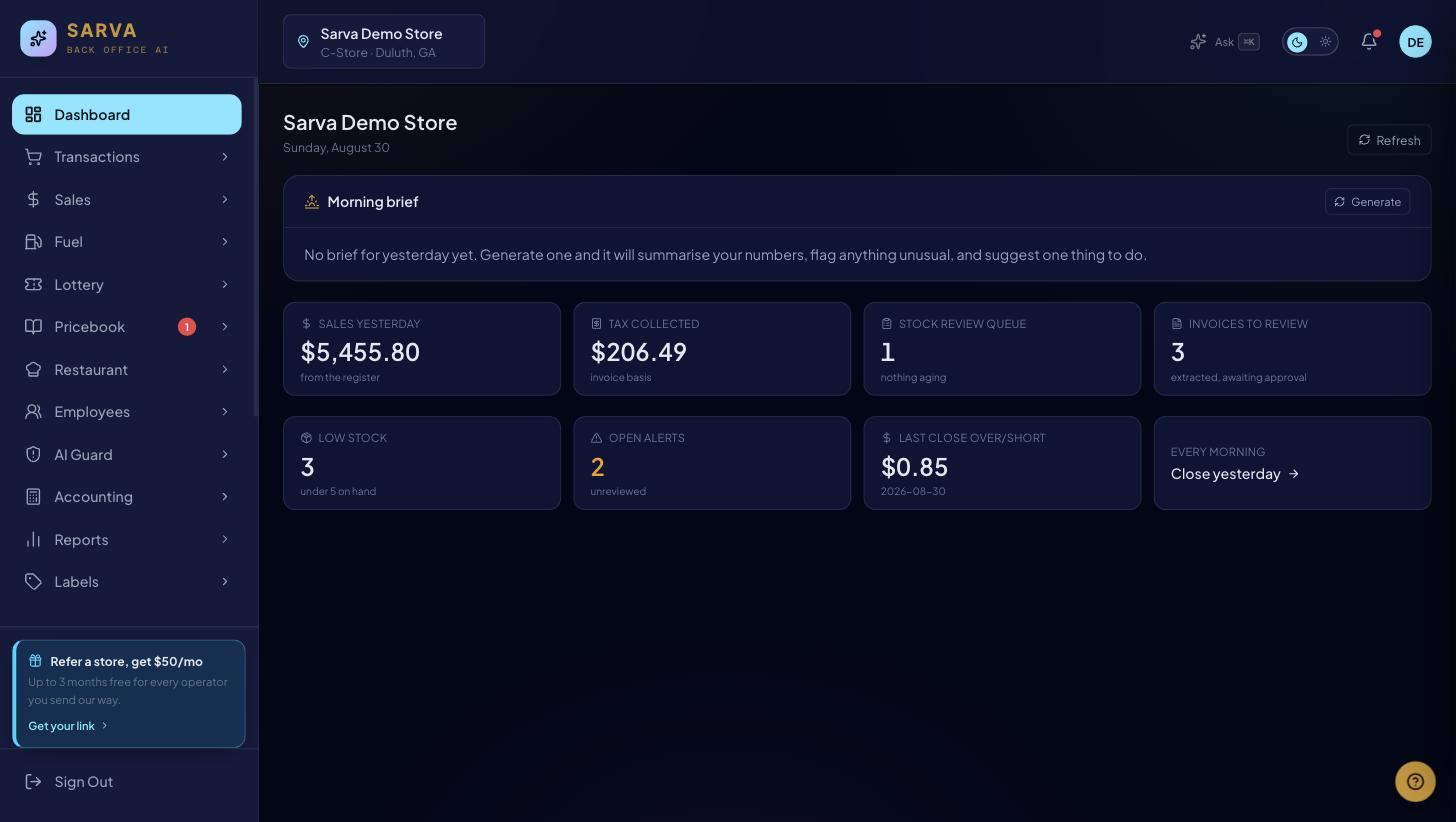
Close the day, count lottery, approve an invoice, adjust stock. The platform records what happened and where it disagrees with what was expected — over/short, variance, unmatched items — rather than asking anyone to compile it later.
Each morning, a brief: yesterday against the same weekday last week, anything unusual, and what has been waiting too long. One concrete thing to do. If the data is not there, it says so instead of estimating.
Sarva was not designed for convenience retail from the outside. It was built by an operator, in his own stores, to solve the problems he had that quarter — and every module in it existed because something was costing him money or hours before it did.
BP 155, a fuel and convenience site in Georgia, is the live pilot: the first store where the register connector, the back office and the camera layer run together. It is also where the figures on the right will come from.
Those are blank because the measurement period is not finished. They will be filled in with what was actually observed, and if a number disappoints it will be published anyway — a case study that only ever reports good results is an advertisement.
The pilot, in numbers
No customer logos are shown because there are no customers to name yet.
Four of the five platforms an operator would otherwise shortlist require a sales call before quoting a price. Ours is on this page.
| Plan | Starter$99/monthOne site, back office and price book. | Operator$199/monthOne site, everything including AI Guard. | Multi-storeTalk to usThree or more sites, or a bespoke integration. |
|---|---|---|---|
| Daily close, tax and tenders | |||
| Price book and inventory | |||
| Invoice AI | 50 / month | Unlimited | Unlimited |
| Ask Sarva | |||
| Lottery | |||
| Fuel and compliance | |||
| Profit Pulse | |||
| AI Guard (cameras) | |||
| Register connector | |||
| Multi-store rollup | |||
| Onboarding | Self-serve | Guided | On-site |
| Start | Start | Talk to us |
Per site, billed monthly, no contract. Cameras are additional hardware and are quoted at cost — existing RTSP or ONVIF cameras usually work, in which case there is nothing to buy. Payment processing is not live yet and is not included in any tier.
Short pieces on the operational problems behind the software. Written from running stores, not from a category report.
Recorded footage answers "what happened" after inventory has already been lost. The argument for analysis at the edge, what it can and cannot detect, and why the useful alert is the one that arrives during the incident.
Not published yetFive subscriptions is the visible cost. The larger one is the reconciliation between them — done by hand, at night, by the person whose time is worth the most. A method for counting what it actually costs your store.
Not published yet